The Beast of Gévaudan: France’s Real Monster — and the Identity Nobody Could Prove
Most legends in this genre dissolve when you look for the bodies. This one is the opposite. Between June 1764 and June 1767, in the old…
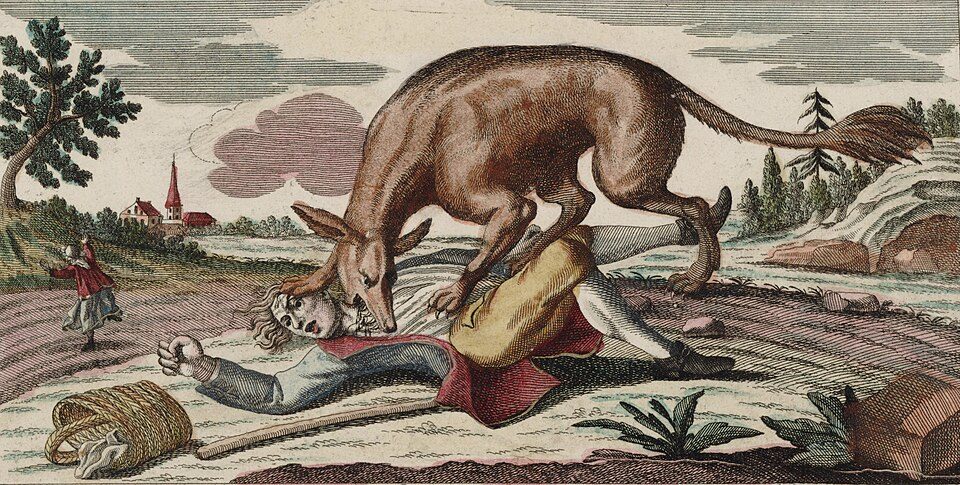 1764 engraving, public domain via Wikimedia Commons
Reader’s note: legends and folklore are presented as reported stories and beliefs, not established fact.
Most legends in this genre dissolve when you look for the bodies. This one is the opposite. Between June 1764 and June 1767, in the old French province of Gévaudan — the rugged, thinly populated country that is now the département of Lozère — something attacked more than two hundred people and killed well over a hundred of them. The king of France sent his personal gun-bearer to deal with it. The press of Europe turned it into what historians now call one of the first international news stories. And after three years of terror, the thing that stopped the killing was a local farmer’s single shot — with a bullet that legend says was made of silver.
This is the story as the records tell it. The records, for once, are unusually good. That doesn’t mean the identity of the beast is settled. It means the mystery is real.
“Like a wolf, yet not a wolf”
The first encounter came in the early summer of 1764, in the Mercoire forest near Langogne. A young woman tending her cattle watched a huge animal emerge from the trees and charge her. She survived only because the bulls of her herd turned and drove the creature off. She described it as wolf-like — but much larger. Like a wolf, yet not a wolf.
Twenty-nine days later, the first body was found. Jeanne Boulet, fourteen years old, was killed on June 30, 1764, her throat torn open. From there the attacks came in waves: two young girls on August 6th and 8th, a fifteen-year-old cowherd on August 30th, and on into the winter. The victims were overwhelmingly women and children, usually alone, often tending livestock — and again and again, the livestock itself was left untouched. The killer, witnesses said, preferred human throats, sometimes devoured its victims partially, and walked away from herds it could have taken with ease. One 1764 broadsheet, trying to pin the creature down, described it this way: reddish-brown, with a dark ridged stripe down the back; resembling a wolf or hyena but as big as a donkey; a long gaping jaw, six claws, pointed upright ears, and a supple, furry tail “mobile like a cat’s” that could knock a person down. Its cry, witnesses added, sounded more like a horse neighing than a wolf howling.
The body count is itself part of the fog. A 1987 study of the contemporary records counted 210 attacks: 113 dead, 49 injured, 98 of the dead partly eaten. More conservative tallies put the deaths between sixty and a hundred. The newspapers of 1764 claimed far more — hundreds. The spread between those numbers tells its own story: some deaths entered the count through parish registers where a priest simply wrote that a beast had done it; others arrived through letters, rumors, and newspaper columns. But strip away every exaggeration and the floor is still staggering: by any count, this was the deadliest series of animal attacks in French history, and it was recorded by people with a professional obligation to accuracy — priests, administrators, soldiers.
The nation takes notice
The story broke in the Courrier of Avignon and was quickly taken up by the Paris papers; from there it crossed borders. A German print from September 1764 shows the beast looking like a quadrupedal kangaroo attacking a well-dressed man in a Teutonic landscape — the 18th-century equivalent of a viral post, mangled in the retelling. It was, in a real sense, the first viral news story: a provincial monster, serialized across Europe.
King Louis XV intervened. He offered a bounty worth several thousand livres — roughly what an ordinary man earned in a year — and the region filled with hunters. Tens of thousands of men swept the hills of Gévaudan. The king deployed a dragoon captain, Jean-Baptiste Duhamel, with royal troops; when Duhamel failed, he was replaced by Jean-Charles Vaumesle d’Enneval, the most celebrated wolf-hunter in Normandy, and his son. D’Enneval failed too.
None of them could corner an animal that hunters had already shot at — and, according to reports, sometimes struck — only to watch it run off seemingly unharmed. That’s where the werewolf rumors took root: witnesses swore bullets couldn’t stop it. In the panic, people read the beast as a shape-shifter, a demon, a punishment. Duhamel, exasperated, declared that the animal was “a monster whose father is a lion.” Nobody had a better explanation.
The ones who fought back
The beast’s legend is carried as much by its survivors as by its victims. A young boy named Jacques Portefaix organized seven other children to drive the animal off when it attacked them — an act of group courage that caught the king’s attention. Louis XV rewarded the children and gave Portefaix a state education. Near Saint-Alban, a mother named Jeanne Jouve defended her children with her bare hands. And then there was Marie-Jeanne Valet.
On August 11, 1765, at Paulhac-en-Margeride, the twenty-year-old servant of the parish priest was walking between farms when the beast came at her. She had armed herself with a spear tipped with a bayonet — this was an animal the whole country feared, and the peasants of Gévaudan traveled ready. When it charged, she planted the weapon in its chest. Witnesses said it bled, pressed a paw to the wound, and fled into the river. She became the Maid of Gévaudan — la Pucelle du Gévaudan — and a statue of her stands in Auvers today. She hurt the beast. She didn’t kill it. Nobody could.
The king’s marksman
Embarrassed by his wolf-hunter’s failure, Louis XV sent his own gun-bearer — François Antoine, the lieutenant of the royal hunt — with a team of handpicked men. On September 21, 1765, Antoine’s party shot a massive wolf in the woods of Chazes: sixty-three kilograms, enormous by any standard, with several cubs. The carcass was stuffed, paraded, and displayed at Versailles as the Beast of Gévaudan. Antoine was celebrated and richly compensated. The victory was declared publicly, and prematurely.
Two months later, the attacks resumed. Between December 1765 and June 1767, some thirty more people died. The press, having lost interest in a story that refused to end neatly, moved on. The authorities, having been embarrassed once, paid little attention. The people of Gévaudan were on their own.
The silver bullet
Jean Chastel was a farmer and hunter from La Besseyre-Saint-Mary, a man of the Margeride hills who had watched the terror for three years. On June 19, 1767, during a coordinated hunt near Auvers, Chastel shot a large, wolf-like animal with features that witnesses said did not match any ordinary wolf — unusually long limbs, powerful jaws. An autopsy found human remains in its stomach.
The attacks stopped. Permanently.
Legend, of course, improved the story: Chastel, the tale goes, had melted down blessed religious medals and cast them into silver bullets, and lured the beast by sitting in a clearing pretending to read the Bible. It is probably no coincidence that the silver-bullet cure for werewolves entered popular imagination around this time — the Gévaudan story is one of its strongest candidates as a source. What we know for certain is thinner and more haunting: the carcass was stuffed and sent toward Paris, but it arrived in such poor condition that it was buried immediately. The one piece of physical evidence that could have settled the identity of the Beast of Gévaudan — the body itself — rotted on the road.
The honest problem
Here is where this case flips the usual folklore script. With the Bell Witch, the problem is that the documentation doesn’t exist. With the Beast of Gévaudan, the problem is that the documentation is too good to dismiss and still not enough to answer the question.
The deaths are real. They were entered into parish registers by priests who buried the bodies. The hunts were conducted by the military. The correspondence of the king’s own household tracks the whole affair. Historian Jean-Marc Moriceau’s research into wolf attacks across France — some 3,000 recorded between the 15th and 20th centuries — confirms the uncomfortable background fact: in the 18th century, wolves attacked and killed people in France routinely, at a rate modern audiences find hard to believe. Gévaudan was not the only place this happened. It was the most concentrated, most publicized, most desperate case of it.
So what was it? The honest answer is a ranked list, and none of the entries are clean:
An oversized wolf — or several. The leading scholarly view. The 1760s were bad years: wolf populations were high, the countryside was poor, and a single bold animal, or a few of them, could have developed a taste for humans. The Chastel animal’s human remains, the throat-first kills, the preference for the vulnerable — all of it fits wolves behaving in the worst way they ever behave. What doesn’t fit is the description: the size, the striping, the cat-like tail, the cry. But descriptions under terror are notoriously unreliable, and the engravers had never seen the beast — they drew from testimony and from imagination.
A wolf-dog hybrid. The Chastel carcass was said to have unusual limbs and jaws; hybrids can be larger and stranger than either parent. Plausible, unprovable.
An escaped exotic. One 1764 print literally labels the beast a hyena. Duhamel’s “father is a lion” theory was absurd and revealing at once — the witnesses kept saying the animal matched nothing they knew. An escaped lion or hyena from a menagerie is the theory the evidence can’t quite rule out. But no menagerie escape was ever documented, and no non-wolf carcass was ever produced.
A trained animal with a human behind it. Some researchers have floated the idea that the beast was a war-dog or hunting animal trained to kill — which would explain the intelligence witnesses reported, the throat-first targeting, and the terror campaign’s strange geography. It would also explain, in the darkest version, the fringe theory of a human serial killer working under cover of the panic. There is no evidence for either. It is worth naming only because the witnesses’ accounts of the beast’s cunning are so consistent — it evaded tens of thousands of hunters for three years — and a cunning wolf is one thing, but this one outsmarted the king’s army.
The press made it larger than it was. The locals, terrified, made it supernatural. The king’s hunters made it a career opportunity. And when the carcass rotted, the mystery fossilized — preserved forever at the exact level of uncertainty where legends live.
Gévaudan is marked by it still. There are monuments in Auvers and La Besseyre-Saint-Mary. The 2001 film Brotherhood of the Wolf — half history, half fever dream — is really about this case wearing a costume. And the honest version of the story is stranger than the film: the beast was real enough to fill the parish registers with the dead. Nobody ever proved what it was.
Frequently Asked Questions
How many people did the Beast of Gévaudan kill?
The most cited modern study (1987) counted 210 attacks with 113 deaths and 49 injuries; 98 of the dead were partly eaten. Conservative estimates say sixty to one hundred dead. Contemporary newspapers claimed far more. The honest answer: the parish registers and official reports confirm dozens of deaths by any definition, and by the 1987 count, 113. No version of the numbers makes this anything but the deadliest series of animal attacks in French history.
Was the beast a werewolf?
Not in any sense the records support. The werewolf reading grew out of two things: witnesses reporting that bullets struck the animal without stopping it, and the beast’s eerie intelligence — it evaded tens of thousands of hunters for three years. Both are explainable without the supernatural: tough, wounded animals run, and wolves that survive hunt pressure get very good at avoiding people. The silver-bullet legend around Jean Chastel’s killing shot helped cement the werewolf association in popular culture, but the contemporary records describe an animal, not a shape-shifter.
Did Jean Chastel really use a silver bullet?
The records confirm that Chastel killed the final animal on June 19, 1767, near Auvers, and that the attacks stopped afterward. The silver bullet — cast from melted-down religious medals, sometimes with Chastel luring the beast by pretending to read the Bible — is legend. It is one of the strongest candidates for the origin of the “silver bullets kill werewolves” trope in popular culture, but it comes from folklore, not from the official record of the kill.
Why did the king’s marksman fail?
François Antoine shot a genuine monster of a wolf — sixty-three kilograms — in September 1765, and it was reasonable to believe he’d ended it. But the attacks resumed in December 1765. The likeliest explanation is that there was never a single animal: the “beast” may have been several bold wolves, or a pack, and killing the biggest one simply left the others. The 1765 kill was a real wolf, publicly displayed at Versailles. It just wasn’t the whole story.
Could it have been an escaped lion or hyena?
It can’t be ruled out — and the theory dates to 1764 itself, when at least one print identified the beast as a hyena. But no escaped exotic was ever documented, no non-wolf carcass was ever produced, and the autopsied Chastel animal was a large canid. Historian Jean-Marc Moriceau’s research documents thousands of wolf attacks on humans across France over the centuries, putting Gévaudan at the extreme end of a real pattern rather than outside it entirely.
Keep exploring
The Jersey Devil: The Monster a Feud Invented and a Panic Made Real
For one week in January 1909, the Jersey Devil was everywhere. It started with strange tracks in the snow. Then the newspapers of Philadelphia, Trenton, and…
Read story →
The Mothman of Point Pleasant: The Real Tragedy Behind the Legend
For thirteen months in 1966 and 1967, the small town of Point Pleasant, West Virginia, lived under the gaze of something with wings and glowing red…
Read story →
The Salem Witch Trials: Two Hundred Accused, Twenty Dead, and Not a Single Witch
Every October, more than a million people pour into Salem, Massachusetts — 1.1 million unique visitors in October 2025 alone, 96,600 of them on Halloween Day…
Read story →