The Mothman of Point Pleasant: The Real Tragedy Behind the Legend
For thirteen months in 1966 and 1967, the small town of Point Pleasant, West Virginia, lived under the gaze of something with wings and glowing red…
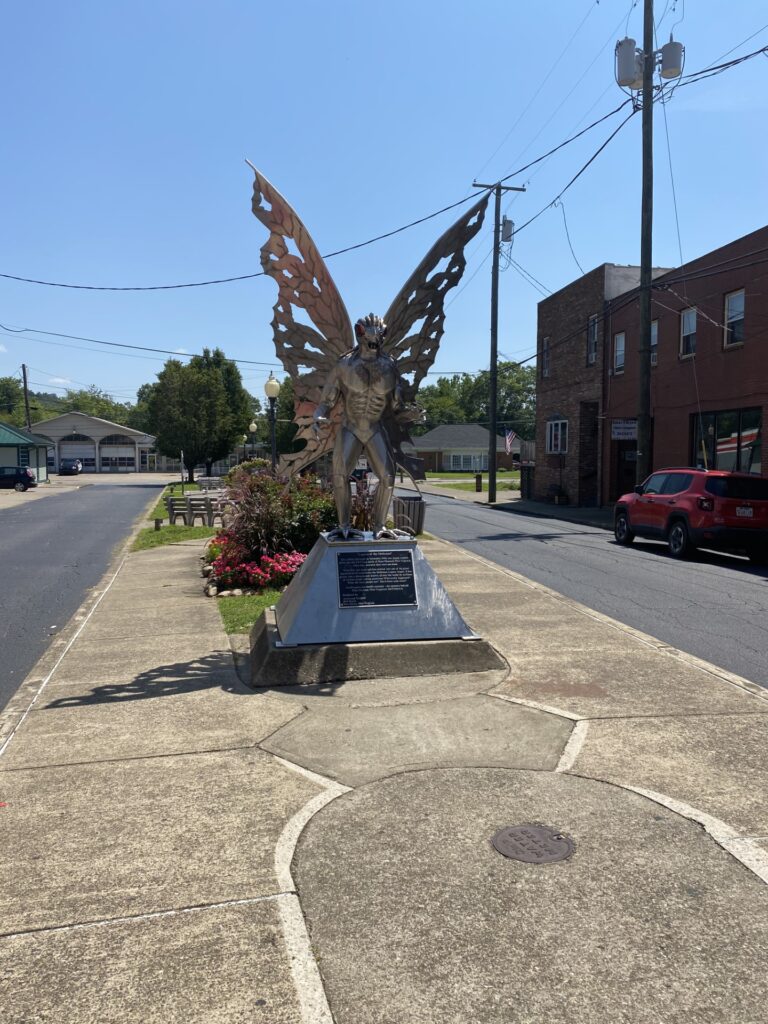 Photo: Csassen13, CC0 via Wikimedia Commons
Reader’s note: legends and folklore are presented as reported stories and beliefs, not established fact.
For thirteen months in 1966 and 1967, the small town of Point Pleasant, West Virginia, lived under the gaze of something with wings and glowing red eyes. Then, on a December evening, the town’s bridge fell into the Ohio River and 46 people died — and the two events fused into one of America’s most enduring legends. This is the story of what was reported, what was documented, and where the two stop agreeing.
The night of November 15, 1966
Late on the night of November 15, 1966, two young couples from Point Pleasant — Roger and Linda Scarberry and Steve and Mary Mallette — were driving through a lonely stretch of road north of town known locally as the TNT area. Near an abandoned power plant, they saw it: a large, dark creature standing by the roadside, somewhere around seven feet tall, with a pair of eyes that glowed red in the dark.
Linda Scarberry later described it as a slender, muscular man with white wings. She said she couldn’t make out its face — the eyes held her gaze with what she called a hypnotic effect. The four of them panicked, piled back into Roger’s 1957 Chevy, and fled. Roger pushed the car to 100 miles per hour down the straight stretch toward town. The creature, they said, took flight and kept pace with them, letting out a screeching sound witnesses compared to a phonograph record played at high speed. It followed them all the way to the Point Pleasant city limits.
They reported it to the police that night. Deputy Millard Halstead took the report; he found no physical evidence, but he noted the genuine distress of the witnesses. The next morning, the Point Pleasant Register ran the story under one of the great headlines in American journalism: “Couples See Man-Sized Bird … Creature … Something!”
Within days, the story went national. An editor at the Athens Messenger in Ohio gave the creature its name — “Mothman,” a nod to Batman and his foe Killer Moth, both all over television that year. The name stuck harder than the facts ever would.
The TNT area
The setting matters, because it explains a lot about what happened next. The “TNT area” was the local name for the West Virginia Ordnance Works, a sprawling former World War II munitions plant a few miles north of Point Pleasant where high-grade explosives had been made and stored. By 1966 it was abandoned: acres of overgrown woods studded with dozens of igloo-like concrete bunkers, murky ponds, and canals that had once connected the facilities.
It was, in other words, exactly the kind of place where strange things get seen — dark, off the main roads, full of shapes that resolve into whatever the viewer fears most. Tour buses full of visitors go there today hoping to soak up the atmosphere. A local historian put it plainly: the area is genuinely creepy, especially at night.
A town starts seeing things
After the newspaper coverage, the sightings multiplied. Over the next thirteen months, roughly a hundred reports came in from in and around Point Pleasant. Two volunteer firemen described “a large bird with red eyes.” A contractor named Newell Partridge told the sheriff that when he aimed a flashlight at a creature in a nearby field, its eyes glowed “like bicycle reflectors” — and blamed the thing for the buzzing on his television set and the disappearance of his German Shepherd, Bandit. Hunting parties went out looking for it. Mason County Sheriff George Johnson offered his own theory: an unusually large heron.
The descriptions stayed remarkably consistent: something between six and seven feet tall, winged, with glowing red eyes, seen rising from the ground, stalking airplanes, chasing cars. Whether that consistency points to a real phenomenon or to a town telling the same story back to itself is the question that has never quite been settled.
What the skeptics say
The skeptical explanations arrived quickly and have never gone away. A wildlife biologist at West Virginia University, Robert L. Smith, told reporters the descriptions fit a sandhill crane — a bird that stands nearly as tall as a human, with a wingspan around seven feet and reddish coloring around its eyes. His theory: a crane blown off its migration route, somewhere it didn’t belong, seen at night by frightened people. Others proposed barred owls or herons, both capable of producing eyeshine that looks uncanny in a flashlight beam.
None of the skeptical theories can be proven from this distance, and none of the sightings can be disproven either. What can be documented is the timeline: the sightings began on November 15, 1966, and they continued for just over a year. Then they stopped — all at once, on the day everything changed.
December 15, 1967
The Silver Bridge carried U.S. Route 35 across the Ohio River between Point Pleasant and Ohio. Officially the Point Pleasant Bridge, it had been nicknamed for the aluminum paint that gave it a silver sheen. It was an eyebar-chain suspension bridge, an unusual design even when it opened on May 30, 1928.
At around 5 p.m. on December 15, 1967 — rush hour, ten days before Christmas — the bridge collapsed. Thirty-one of the 37 vehicles on the span fell into the Ohio River. Forty-six people were killed; two were never found.
Investigators traced the failure to a single eyebar in one of the suspension chains: a cleavage fracture that began at a flaw just a tenth of an inch deep, worsened by stress corrosion and corrosion fatigue. The bridge had been designed for the light automobiles of the 1920s, not the tractor-trailers and buses of the 1960s, and it had been carrying far heavier loads than its designers intended. The collapse led directly to the National Bridge Inspection Standards — the federal requirement that the nation’s bridges be inspected at regular intervals. The Silver Memorial Bridge replaced it in 1969, a mile downriver.
That is the documented history, and it needs no legend attached to it. It was a failure of engineering, maintenance, and oversight — one of the deadliest bridge collapses in American history, and the reason every bridge you drive over today gets inspected.
Harbinger of doom?
Here is where the two threads — the reported sightings and the documented disaster — get braided together, and where they need to be carefully unbraided.
The idea that Mothman predicted or caused the collapse comes almost entirely from one source: investigative journalist John Keel’s 1975 book The Mothman Prophecies, which wove the sightings together with UFO reports, “men in black” encounters, and alleged precognitions into a single paranormal tapestry. (An earlier book, Gray Barker’s The Silver Bridge from 1970, had explored similar territory in what even sympathetic accounts describe as a heavily fictionalized way.) Keel’s book became a 2002 film starring Richard Gere, and the film cemented the harbinger version of the story in the public mind.
The people of Point Pleasant have always been more cautious about the connection than the legend industry. Local accounts stress that after the bridge fell, the Mothman talk simply stopped — a town in mourning had no appetite for monster stories, and, as one local historian put it, the disaster “was too real.” There is no documented sighting of the creature on or near the bridge before the collapse; the link is Keel’s construction, not the witnesses’.
Believers tend to split into two camps: those who say the creature somehow caused the collapse, and those who cast it as a harbinger of doom — a warning, not a weapon. Skeptics note the simpler reading: a frightening local flap of sightings, a genuine engineering catastrophe thirteen months later, and a storyteller who joined them after the fact.
Point Pleasant today
Whatever it was, the town decided to keep it. In 2002, Point Pleasant held its first annual Mothman Festival — a one-day event that has grown into a full weekend every September, now drawing 15,000 or more visitors to a town of fewer than 5,000. In 2003, the town unveiled a 12-foot stainless steel statue of the creature by artist Bob Roach on Main Street; it’s the town’s most photographed spot. Jeff Wamsley, a Point Pleasant native, opened the Mothman Museum and Research Center in 2006, archiving police reports, witness accounts, and memorabilia from the 1966–67 flap.
The statue’s plaque tells the legend straight, the way the town wants it told. And the town’s attitude, six decades on, was summed up by a museum employee: the best part about Mothman is that we don’t know what he is.
That’s the honest version of the whole story. Something was seen — by credible, frightened people, more than a hundred times. Something else happened — a bridge fell, and 46 people died, for reasons engineers can explain down to a tenth of an inch of cracked steel. The legend lives in the space between those two facts, and it will probably outlive everyone who tries to close it.
Frequently Asked Questions
What is the Mothman?
The Mothman is a legendary winged humanoid reportedly seen around Point Pleasant, West Virginia, between November 1966 and December 1967. Witnesses described a creature six to seven feet tall with glowing red eyes. Skeptics attribute the sightings to misidentified birds such as sandhill cranes or owls; no physical evidence of the creature was ever found.
When was the first Mothman sighting?
The first widely reported sighting was on the night of November 15, 1966, when two couples — Roger and Linda Scarberry and Steve and Mary Mallette — reported a winged creature chasing their car near the TNT area north of Point Pleasant. The Point Pleasant Register published the story the next morning.
Did the Mothman cause the Silver Bridge collapse?
There is no evidence connecting the creature to the collapse. The Silver Bridge fell on December 15, 1967, because of a fractured eyebar weakened by stress corrosion and heavier-than-designed traffic loads, killing 46 people. The “harbinger of doom” framing comes from John Keel’s 1975 book The Mothman Prophecies and its 2002 film adaptation, not from the original witness reports.
Where can I see the Mothman statue?
The 12-foot stainless steel Mothman statue by artist Bob Roach stands on Main Street in Point Pleasant, West Virginia, unveiled in 2003. The Mothman Museum and Research Center is nearby, and the town hosts the annual Mothman Festival each September.
Is the Mothman still seen today?
Reported sightings around Point Pleasant largely stopped after the 1967 bridge collapse. Occasional “Mothman-like” reports surface elsewhere — most notably a flap of sightings in Chicago in 2019 — but none have been substantiated, and the legend’s home remains Point Pleasant.
Keep exploring
The Jersey Devil: The Monster a Feud Invented and a Panic Made Real
For one week in January 1909, the Jersey Devil was everywhere. It started with strange tracks in the snow. Then the newspapers of Philadelphia, Trenton, and…
Read story →
The Beast of Gévaudan: France’s Real Monster — and the Identity Nobody Could Prove
Most legends in this genre dissolve when you look for the bodies. This one is the opposite. Between June 1764 and June 1767, in the old…
Read story →
The Salem Witch Trials: Two Hundred Accused, Twenty Dead, and Not a Single Witch
Every October, more than a million people pour into Salem, Massachusetts — 1.1 million unique visitors in October 2025 alone, 96,600 of them on Halloween Day…
Read story →