Bloody Mary: The 200-Year-Old Mirror Game Behind the Bathroom Chant
You know the rules. Dark bathroom. Mirror. Candle, if you're feeling traditional. Say her name three times — some versions say thirteen, some say forty-seven —…
 Public domain via Wikimedia Commons
Reader’s note: legends and folklore are presented as reported stories and beliefs, not established fact.
You know the rules. Dark bathroom. Mirror. Candle, if you’re feeling traditional. Say her name three times — some versions say thirteen, some say forty-seven — and she appears in the glass: a corpse, a witch, a woman covered in blood. She might scream at you. She might scratch your eyes out. She might steal your soul.
Millions of kids have played it at sleepovers. Almost none of them know they’re performing a ritual that’s centuries older than the dare — or that folklorists have been studying it since the 1970s.
The ritual
The modern game took its familiar shape in the late 1960s. The setup is always some variation on the same scene: a dim or candle-lit room, almost always a bathroom, a mirror, and a group of kids working up their nerve. The name is chanted into the glass — “Bloody Mary” three times is the classic, though regional variants demand thirteen repetitions at midnight, or spinning around first, or pricking a finger and offering a drop of blood.
She doesn’t always go by Bloody Mary. Folklorists have recorded her as Hell Mary, Mary Worth, Mary Worthington, Mary Whales, Mary Lou, Black Agnes, and — in the Netherlands — Zwarte Piet’s sinister cousin, Black Madame. The name changes by region and by decade. The mirror never changes.
What she does when she arrives is where the tellers get creative: she screams, she curses, she strangles, she drinks your blood, she scratches your face — the scratched cheek is the most common injury in the collected accounts. Sometimes she’s a grieving mother. Sometimes she’s a witch executed long ago. Sometimes she died on her wedding night. The backstory is always tragic, and it’s always different.
The 200-year-old game
Here’s the part the sleepover version leaves out: people were staring into mirrors in dark rooms looking for faces long before anyone chanted “Bloody Mary.”
In the 1800s, the ritual was about love, not death. A young woman would walk backward up a flight of stairs holding a candle and a hand mirror, in a darkened house, and gaze into the glass hoping to glimpse her future husband’s face. The catch — the part that made it a dare — was that she might see a skull instead, or the face of Death himself. That meant she would die before she ever married.
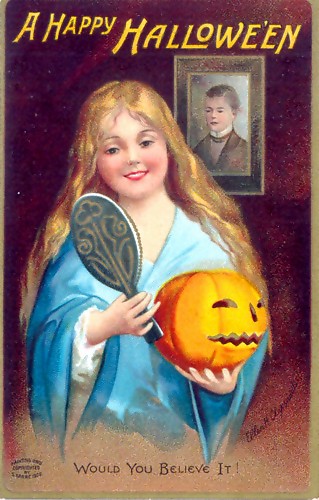
Robert Burns described mirror-gazing Halloween rituals in his 1785 poem “Halloween.” By the early 1900s, the custom was so well known it showed up on Halloween greeting cards — like the 1904 postcard illustrating this article, where a girl holds a hand mirror beside a grinning jack-o’-lantern under the caption “Would You Believe It!”
The mechanism has a name: catoptromancy, divination by mirror. Mirrors have been treated as thresholds — surfaces where the other world shows through — across centuries of folk belief. The bathroom version of the game kept the mirror, the darkness, and the face in the glass. It just swapped the husband for a monster.
The folklorists who wrote it down
Bloody Mary is one of the rare urban legends with a paper trail in academic folklore.
In 1978, folklorist Janet Langlois published “‘Mary Whales, I Believe in You’: Myth and Ritual Subdued” in the journal Indiana Folklore. She had collected seventeen texts of the legend — twelve of them gathered in Indianapolis in 1973 — and interviewed eighty students at an Indianapolis elementary school. About a quarter of them knew “the Mary Whales thing”; about half of those had actually played it. Langlois was interested in the chicken-and-egg question of myth and ritual: does the story produce the game, or the game the story? Her reluctant conclusion was that, for the kids she studied, neither came first — they arrived together.
Twenty years later, folklorist Alan Dundes took up the ritual in the journal Western Folklore (1998). His reading was psychological: the dark room, the mirror, the summoned name, the sudden blood — he argued it all maps onto the bodily anxieties of pre-adolescence. The ritual, in his view, is a folk drama about growing up, staged in front of a bathroom mirror.
Langlois noticed something else, something the kids themselves seemed to understand intuitively: the mirror’s function is identification. Stare long enough into a dark mirror while chanting, and the face looking back stops looking like you. Participants describe their own features distorting in the gloom — foreheads lengthening, eyes turning to black pools. The apparition in the glass is, at least partly, the player.
Who is she supposed to be?
Ask for Bloody Mary’s “true story” and you’ll get a menu of tragic women, none of whom can be confirmed.
The most repeated candidate is Mary I of England (1516–1558), the Catholic queen whose persecution of Protestants — nearly 300 burned at the stake — earned her the nickname “Bloody Mary.” It’s a good story, and it has almost no evidence behind it beyond the shared name. Folklorists note there is little connecting the Tudor queen to the mirror ritual.
Then there’s Elizabeth Báthory, the Hungarian countess of the early 1600s, around whom legends of blood-bathing grew — another theory with more atmosphere than documentation. The “Mary Worth” variant is usually attached to a witch-trial victim or a woman murdered in the woods, depending on who’s telling it. The grieving-mother version — a woman who lost her children and now scratches the faces of other people’s — shows up in dozens of regional tellings.
The honest answer is that Bloody Mary has no certain owner. The name is a vessel that each generation fills with its own anxieties: queens, witches, mothers, murder victims. The ritual is the constant; the woman is interchangeable.
Why it still works
The dare survives because it’s engineered to work — on your nerves, if not on the spirit world.
Part of it is the setting. A dark, locked bathroom is already a vulnerable place; chanting in unison with a group already raises the heart rate. Part of it is the mirror itself. Stare into a dim mirror long enough and your own face begins to misbehave — features blur, shadows pool in the eye sockets, the reflection stops tracking your expectations. It’s the same reason the game is almost always played in groups: the USC Digital Folklore Archives’ student accounts describe it as a bonding ritual, a test of bravery, a way to scare each other and laugh about it after. The fear is the point, and the safety of the group is what makes the fear fun.
That’s also why the legend travels so well. Japan has Hanako-san, the school-bathroom ghost summoned in front of a mirror. Czech kids tell of Krvavá Máří. The details are local; the machinery — darkness, glass, a name spoken aloud, a face that isn’t yours — is universal.
And it’s why Bloody Mary keeps getting remade. The ritual had its TV afterlife in a 2005 episode of Supernatural and its own horror film the same year (Urban Legends: Bloody Mary). Each retelling sandpapers the edges a little further from the 19th-century staircase and a little closer to the bathroom mirror. But strip away the pop culture and you’re left with what was always there: a dark room, a piece of glass, and the oldest dare there is — look long enough, and see what looks back.
That’s the honest version. Nobody named Mary haunts America’s bathrooms. What haunts them is older and stranger: a divination game from the 1800s that taught girls to look for their future in a mirror, a skull that crept into the glass somewhere along the way, and a name — borrowed from queens and witches and nobody in particular — that turned a parlor game into a dare. The mirror never needed a ghost. It only needed you, in the dark, saying the name.
Frequently Asked Questions
How do you play the Bloody Mary game?
The classic version: go into a dark bathroom with a mirror (traditionally with a candle), chant “Bloody Mary” three times into the glass, and wait for her apparition to appear. Variants call for thirteen repetitions at midnight, spinning around before looking, or pricking a finger for a drop of blood. Regional versions use different names, including Mary Worth, Hell Mary, and Black Agnes.
Is Bloody Mary based on a real person?
No version can be confirmed. The most commonly cited candidate is Mary I of England (1516–1558), nicknamed “Bloody Mary” for executing nearly 300 Protestants — but folklorists note there is little evidence connecting her to the mirror ritual beyond the name. Other theories name Elizabeth Báthory, a witch-trial victim called Mary Worth, or a grieving mother. The legend’s “true origin” stories are later additions, not documented history.
Why is the ritual always done in a bathroom mirror?
The modern form of the legend coalesced in the late 1960s as a sleepover dare, and bathrooms were the available dark, lockable room with a mirror. But the deeper root is catoptromancy — mirror divination — which goes back centuries: 19th-century Halloween customs had young women gazing into mirrors in darkened houses to glimpse their future husband’s face, or a skull if they were doomed to die unmarried.
Why do people see faces in the mirror?
Staring into a dim mirror for an extended time makes your own reflection appear to distort — features blur, shadows deepen, and the face can stop looking like you. Combined with chanting, darkness, and a group’s rising nerves, the effect is powerful enough that participants genuinely report seeing a stranger in the glass. Folklorist Alan Dundes (1998) also argued the ritual channels pre-adolescent anxieties about the body and identity.
Is Bloody Mary related to Japan’s Hanako-san?
They’re parallel legends, not directly related. Hanako-san is a Japanese school-bathroom ghost, said to haunt a specific toilet stall and appear when summoned — a striking structural match for Bloody Mary (dark bathroom, summoned spirit, mirror or stall). Folklorists treat them as independent versions of the same universal machinery: a liminal space, a spoken summons, and a face that appears where it shouldn’t.
Keep exploring
The Salem Witch Trials: Two Hundred Accused, Twenty Dead, and Not a Single Witch
Every October, more than a million people pour into Salem, Massachusetts — 1.1 million unique visitors in October 2025 alone, 96,600 of them on Halloween Day…
Read story →
Jack the Ripper: Five Women, One Autumn, and a Name Made of Ink
Jack the Ripper is the most famous name in true crime. It has filled libraries, launched a hundred suspects, and sold walking tours through Whitechapel every…
Read story →
The Lost Colony of Roanoke: One Word, 115 People, and 400 Years of Searching
On August 18, 1590, Governor John White waded ashore on Roanoke Island expecting to find his family. His daughter Eleanor was there. His son-in-law Ananias Dare…
Read story →