The Lost Colony of Roanoke: One Word, 115 People, and 400 Years of Searching
On August 18, 1590, Governor John White waded ashore on Roanoke Island expecting to find his family. His daughter Eleanor was there. His son-in-law Ananias Dare…
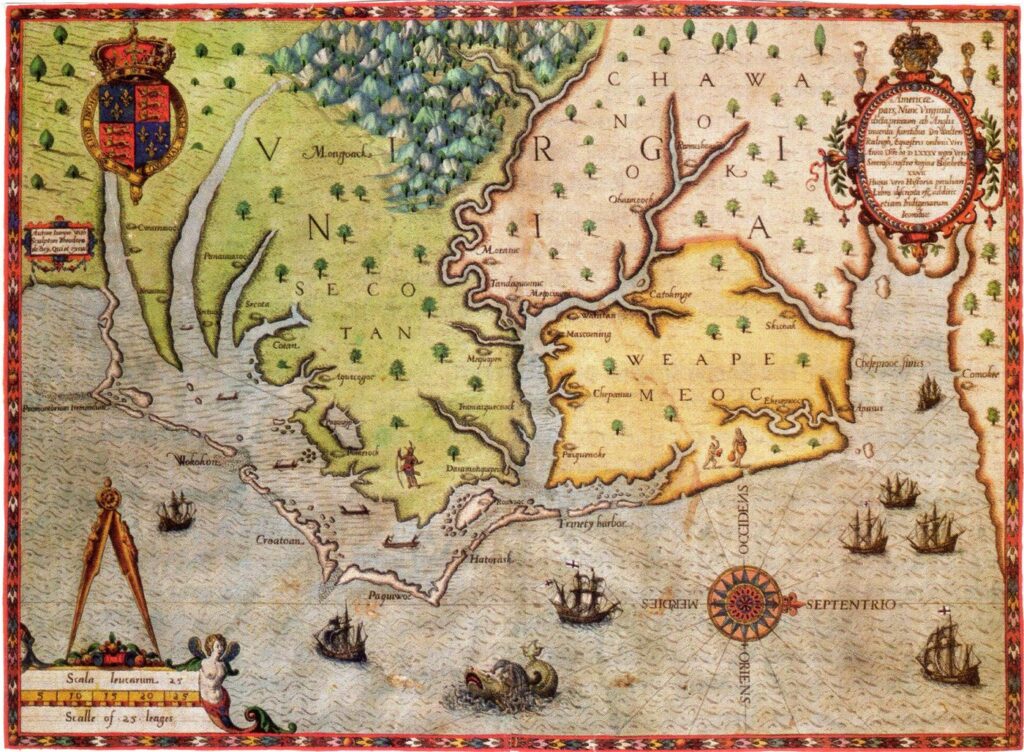 Public domain via Wikimedia Commons (Theodor de Bry, map of Virginia, 1591, after John White)
Reader’s note: legends and folklore are presented as reported stories and beliefs, not established fact.
On August 18, 1590, Governor John White waded ashore on Roanoke Island expecting to find his family. His daughter Eleanor was there. His son-in-law Ananias Dare was there. His granddaughter Virginia Dare — the first English child born in the Americas, born on that island three years earlier to the day — was there, turning three years old.
Instead, White found an empty fort, houses taken down, and a single word carved deep into a palisade post in fair capital letters: CROATOAN.
About 115 men, women, and children were gone. There were no bodies. There were no graves. There was no sign of a struggle, and no sign of where they had gone — except that one word, and one thing that was not there: the cross the colonists had agreed to carve if they left in distress. The post carried the name. It did not carry the cross.
The Lost Colony of Roanoke is America’s oldest unsolved mystery, and it has been open continuously since that afternoon — more than 435 years. It has also been one of the most lied-about. A set of carved stones in the 1930s offered a complete answer, and the answer was a fraud. A famous legend about Virginia Dare turning into a white deer is a literary invention. And the word itself, CROATOAN, has been treated as a code, a curse, and a ghost story — when it was, in fact, an address.
The colony
Roanoke was England’s second attempt at the island, and the first one had already gone wrong. In 1585, Sir Walter Raleigh sent a military outpost of about 107 men under Ralph Lane. They built a fort, clashed with the neighboring Algonquian peoples, and were evacuated by Francis Drake the following year. The relationships they left behind were damaged.
The 1587 expedition was meant to be different: not soldiers, but families — a civilian colony chartered on January 7, 1587, as “The Cittie of Raleigh in Virginea,” with John White as governor. White was an artist and mapmaker who had sailed with the first expedition and drawn the coast and its people. About 115 colonists landed on Roanoke Island in July 1587. Among them were White’s daughter Eleanor Dare and her husband Ananias.
Two events in August 1587 frame everything that followed. On August 13, Manteo — a Croatoan man who had traveled to England with the 1584 expedition and returned as the colonists’ most important ally — was baptized and named Lord of Roanoke and Dasamunkepeuc, the first formally titled Englishman of Indigenous descent. On August 18, Eleanor gave birth to Virginia Dare, the first English child born in the Americas.
Nine days later, on August 27, White sailed for England to fetch supplies. The colonists persuaded him to go; he expected to return within a few months. Instead, England went to war with Spain. Every ship was needed against the Spanish Armada of 1588, and White could not get back to Roanoke for three years.
He landed on August 18, 1590 — Virginia Dare’s third birthday.
What White found
White wrote down what he found, and his account — published in Richard Hakluyt’s Principal Navigations in 1600 — is the only first-person record of the empty colony. It is worth reading closely, because almost everything true about Roanoke is in it, and almost everything false about Roanoke ignores it.
The houses had been “taken downe” — dismantled, not burned or broken. In their place stood a high palisade of great trees, “very Fort-like,” stronger than the one White had left. On a tree near the shore, three letters had been cut: CRO. On a chief post at the entrance to the palisade, carved deep in fair capital letters, was the single word CROATOAN. There was no cross anywhere.
That absence is the most important piece of evidence in the whole case. Before White sailed in 1587, he and the colonists had agreed on a signal: if they had to leave Roanoke, they would carve the name of their destination — and if they left under attack or in distress, they would add a cross. The post carried the name. It did not carry the cross. Whatever happened, the colonists who carved it were not, by their own signal, fleeing for their lives.
White also found his buried chests dug up and rifled, and iron and heavy objects lying in the grass — signs that the site had been picked over after the colonists left, not that they had been attacked. He found no bodies, no graves, and no sign of violence.
White read the carving the way it was meant to be read: as a forwarding address. Croatoan was a real island about fifty miles south — now Hatteras Island — and the home of Manteo’s people, the colonists’ allies. White tried to sail there, but rough weather and a lost anchor forced his ships back to England. He never returned to the New World. No English search party was ever sent.
The word
CROATOAN has done more cultural work than any other single word in American history. It has been a horror-movie title, a television curse, a ghost story, and a synonym for vanishing. Almost none of that has anything to do with what the word was.
Croatoan was the name of a real island and a real people — the Algonquian community on what is now Hatteras Island, who had been friendly to the English from the first voyage. Manteo was Croatoan. The carving was not a code, a warning, or a riddle. It was a note left for a man who was expected to come back: we went to Croatoan.
That reading is the one most historians hold, and the archaeology of the last thirty years has been testing it rather than replacing it. The colonists did not vanish into thin air. The likeliest story — and the one the evidence keeps pointing toward — is that they split into smaller groups and went to live among the Native peoples who already inhabited the region. The Lumbee people of Robeson County, North Carolina, have long held traditions of descent from the colonists. In 1701, the explorer John Lawson traveled through the region and recorded meeting Hatteras people. The mystery is not that the colonists disappeared. It is that no grave, no house, and no name has ever been confirmed.
The stones that lied
For three centuries, the Lost Colony had no ending. Then, in the late 1930s, one arrived — carved in stone, forty-eight times.
In November 1937, a California tourist named Louis Hammond showed up at Emory University in Atlanta carrying a 21-pound stone he said he had found near the Chowan River. Its inscription, in what purported to be old English, read that Ananias Dare and Virginia “went hence Unto Heaven 1591” — and its reverse promised another stone marking a mass grave. The historian Haywood Pearce Jr. of Brenau College authenticated it, and a reward was offered for more stones.
More stones came. By December 1940, there were forty-eight, and together they told a complete story: the colonists’ migration inland, their deaths, their burial. All but the first were eventually connected to a single man — Bill Eberhardt, a Georgia stonecutter with a history of forging Native American artifacts. The “discoverers” who brought stones in turned out to be Eberhardt’s friends. His finds, which began hundreds of miles apart, ended up clustered within a few miles of his own home.
The unravelling came from a journalist. Boyden Sparkes, assigned by the Saturday Evening Post to verify Pearce’s account, published his exposé on April 26, 1941: Eberhardt’s forgery history, the closed circle of finders, and linguistic anachronisms no 1590s writer would have produced. Eberhardt later confessed to participating in the hoax and accepting payment for it — then denied the sworn statements. Pearce Jr. acknowledged he had been deceived.
The honest footnote is the first stone. Hammond’s 1937 stone has never been conclusively proven or disproven — it is a different object from the Eberhardt chain, and it remains unauthenticated rather than exposed. But a disputed object does not become genuine merely because the case against the others is stronger. The Dare Stones are not evidence of what happened to the colony. They are evidence of something else: that a mystery this old creates a market for endings, and that a satisfying ending gets less scrutiny than it deserves.
What the ground says now
The real evidence of the last thirty years is quieter than carved stones, and it points in the same direction the carving did.
First, the weather. In 1998, climatologist David Stahle and archaeologist Dennis Blanton published tree-ring data from bald cypress trees in the Tidewater region, covering 800 years. The colonists had landed at the start of the worst drought in that entire span: 1587 was the worst growing season in 800 years, and 1587–1589 was the driest three-year stretch in the whole reconstruction. The drought would have destroyed the corn crops both the colonists and their Algonquian neighbors depended on — and it helps explain why the colonists would leave an island that could no longer feed them, and why their neighbors had little to spare.
Second, Hatteras. Since 2009, archaeologist Mark Horton of the University of Bristol and local historian Scott Dawson have dug at the Cape Creek site near Buxton, on the island the carving named. They have found European objects mixed with Croatoan materials — a rapier handle, a gunlock, English pottery. In May 2025, they announced the strongest find yet: large quantities of hammerscale, the tiny iron flakes that fly off when a blacksmith hammers hot metal, in a layer preliminarily dated to the late 1500s. Their argument is that hammerscale is a waste product, not a trade good, and that the Croatoan people did not forge iron — so an English smith must have worked there. The caveats are real: no forge hearth has been found, the dating is contested, and the results have not been peer-reviewed. It is the best physical evidence yet. It is not proof.
Third, the map. In 2011, researchers at the First Colony Foundation noticed two patches on John White’s own working map of the coast, La Virginea Pars, held by the British Museum. Under one patch, revealed by lightbox examination in 2012, was a small fort symbol at the confluence of the Roanoke and Chowan rivers, about fifty miles inland — a place the digs now call Site X. Excavations there have turned up English pottery of the right period. In June 2026, the Foundation declared the colony found. But like the Hatteras claim, it rests on artifacts, not graves, remains, or house sites — and the National Park Service’s position stands: no one has definitively proven what happened.
The pattern across all three threads is the same. The colonists most likely split into groups and lived among Native communities — some at Croatoan, some inland. The evidence is real, it is accumulating, and it has not yet produced a single confirmed colonist.
The legends
Everything supernatural about Roanoke is later invention, and the most famous legend has a known author and date. The story of Virginia Dare transformed into a white doe — a beautiful white deer glimpsed on the island, the lost child in animal form — was popularized by a poem and a novel in the early 1900s, more than three centuries after the colony vanished. It is a lovely story. It is not part of the record.
The same is true of the hauntings that now attach to the island: ghostly voices in the fort, the figures in the trees, the staged ghost hunts. They belong to the tourism of the mystery, not to its history. The island itself is a National Historic Site — Fort Raleigh, at the north end of Roanoke Island near Manteo — and the story is told every summer in The Lost Colony, the outdoor drama staged at the Waterside Theatre since 1937. The earthwork fort there was located by archaeologists in 1947 and rebuilt in 1950. But the exact site of the 1587 colony has never been found, and much of the shoreline it stood on has eroded into the sound.
Why it endures
Roanoke endures because it is the rare mystery where the evidence is genuinely thin and the stakes are genuinely human. There was no monster, no curse, and no conspiracy — just 115 people, a three-year gap in the record, and a single word carved on a post by people who expected to be followed.
The honest verdict is quieter than the legend, and more interesting than a disappearance. The colonists did not vanish. They left — deliberately, in an orderly way, during the worst drought in 800 years — and they left a forwarding address. The archaeology now suggests they did what people in their position have always done: they went to the people who would take them in, split into groups small enough to feed, and became part of communities that already knew how to live on that coast. The word on the post was not a mystery. It was the answer, written in plain language, and it took four centuries for anyone to take it at its word.
What remains unknown is everything personal: no grave, no house, no name. Virginia Dare was three years old when her grandfather came back for her. Whether she lived to grow up among the Croatoan, or died in the drought years, is something the ground has not yet said — and may never say.
Frequently Asked Questions
What happened to the Lost Colony of Roanoke?
In 1587, about 115 English colonists settled on Roanoke Island under Governor John White. White sailed to England for supplies in August 1587, and war with Spain delayed his return until August 18, 1590, when he found the settlement empty. The only clue was the word CROATOAN carved on a post, with no cross — the agreed signal for distress. The leading explanation, supported by archaeology, is that the colonists split into groups and lived among neighboring Native peoples, particularly the Croatoan on Hatteras Island. No grave, house, or individual colonist has ever been confirmed.
What does CROATOAN mean?
Croatoan was the name of a real island — now Hatteras Island, about fifty miles south of Roanoke — and of the Algonquian people who lived there, allies of the colonists. The carving was a forwarding address, not a code: the colonists were telling White where they had gone. The absence of the cross they had agreed to carve in distress is the key detail — by their own signal, they did not leave under attack.
Were the Dare Stones real?
No — with one footnote. Between 1937 and 1940, forty-eight inscribed stones surfaced claiming to be messages from Eleanor Dare describing the colonists’ fate. All but the first were traced to Georgia stonecutter Bill Eberhardt, who had a history of forging artifacts; a 1941 Saturday Evening Post exposé by Boyden Sparkes exposed the hoax, and Eberhardt later confessed to participating in it. The first stone, brought to Emory University in 1937 by Louis Hammond, has never been conclusively proven or disproven — but it remains unauthenticated, not evidence.
Did the colonists join Native American communities?
That is the leading theory, and the evidence for it is growing. Archaeology on Hatteras Island has found European objects in Croatoan contexts, and in 2025 researchers announced blacksmithing hammerscale in a layer dated to the late 1500s — though the results are not yet peer-reviewed. Digs at Site X, inland at the Roanoke-Chowan confluence, have found English pottery of the right period. The Lumbee people of North Carolina have long held traditions of descent from the colonists. The National Park Service’s position is that no one has definitively proven what happened.
Can you visit Roanoke Island?
Yes. The site is protected as Fort Raleigh National Historic Site at the north end of Roanoke Island, near Manteo, North Carolina. The reconstructed earthwork fort, the Elizabethan Gardens, and the Waterside Theatre — home of The Lost Colony outdoor drama, staged every summer since 1937 — are all there. The exact site of the 1587 settlement has never been found, and much of the shoreline it stood on has eroded away, but the island is where the story happened, and it is open to the public.
Keep exploring
The Salem Witch Trials: Two Hundred Accused, Twenty Dead, and Not a Single Witch
Every October, more than a million people pour into Salem, Massachusetts — 1.1 million unique visitors in October 2025 alone, 96,600 of them on Halloween Day…
Read story →
Jack the Ripper: Five Women, One Autumn, and a Name Made of Ink
Jack the Ripper is the most famous name in true crime. It has filled libraries, launched a hundred suspects, and sold walking tours through Whitechapel every…
Read story →
Dyatlov Pass: Nine Hikers, One Night, and the File That Won’t Stay Closed
On February 26, 1959, a search party climbing a frozen slope in the northern Ural Mountains found a tent half-buried in snow. It had been cut…
Read story →