Jack the Ripper: Five Women, One Autumn, and a Name Made of Ink
Jack the Ripper is the most famous name in true crime. It has filled libraries, launched a hundred suspects, and sold walking tours through Whitechapel every…
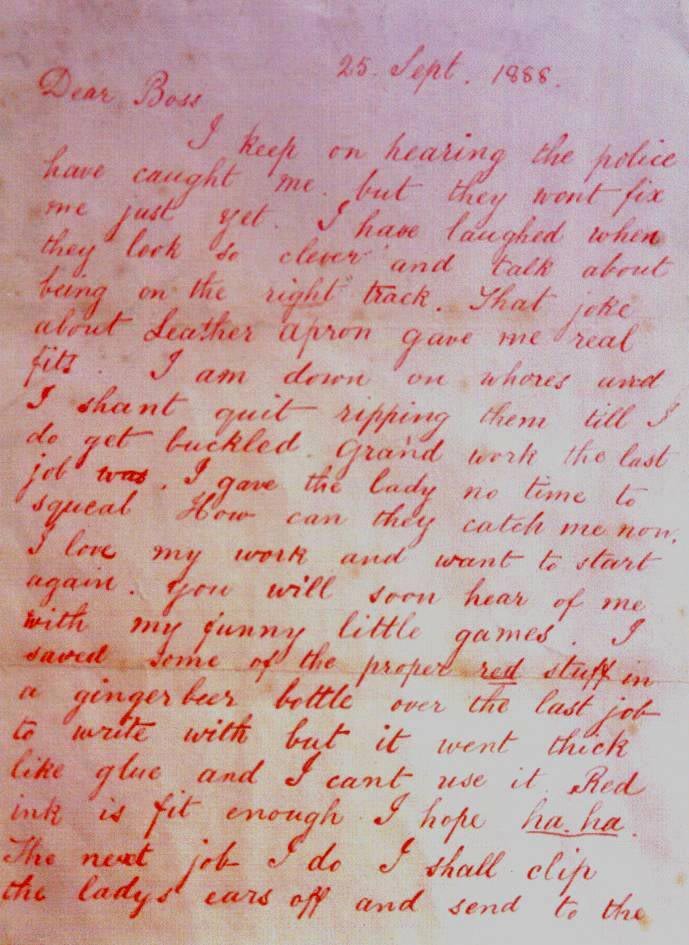 Public domain via Wikimedia Commons ("Dear Boss" letter, September 25, 1888)
Reader’s note: legends and folklore are presented as reported stories and beliefs, not established fact.
Jack the Ripper is the most famous name in true crime. It has filled libraries, launched a hundred suspects, and sold walking tours through Whitechapel every night for decades. And it probably came from a hoax.
The name appears nowhere in police evidence until September 27, 1888, when a letter arrived at a London news agency, written in red ink and signed “Jack the Ripper.” Senior police officers said at the time — and in their memoirs afterward — that it was the work of a journalist. The killer, whoever he was, never gave himself a name. The newspapers did it for him.
What is solid is smaller and grimmer than the legend. Between August 31 and November 9, 1888, five women were murdered in the streets and rooms of London’s East End, all within about a quarter of a square mile, all within ten weeks. No one was ever charged. The police file stayed open into the twentieth century and is now held at the National Archives. After 137 years, the identity of the killer is still unknown — and almost everything famous about the case, from the letters to the DNA, turns out to be thinner than the headlines claimed.
Whitechapel in 1888
Whitechapel and neighboring Spitalfields were among the poorest, most crowded corners of London — some of the most densely packed slums in Europe. Common lodging houses packed dozens of people into shared rooms, and a single bed cost fourpence a night. For women, the margin between getting by and going under was razor thin: the work open to them — domestic service, charring, laundry, sewing — was badly paid and easily lost. Drink made everything worse. A woman without fourpence slept on the street.
That is the world the five women lived in, and it matters more than anything the killer did. They were not killed because of who they were. They were killed because they were outside, in the dark, in streets where nobody with power was watching.
The murders landed in the middle of a newspaper war. London’s evening papers — above all the Star, founded that year — discovered that Whitechapel sold copies, and the coverage grew more sensational with each killing. The panic had a name before the killer did: the Autumn of Terror. It also had a scapegoat. Early in the case, suspicion fell on a Jewish shoemaker nicknamed “Leather Apron,” and the press whipped up anti-Jewish feeling in a district with a large immigrant population. The man was arrested, produced alibis, and was released. The suspicion lingered anyway — and it would surface again in chalk on a Whitechapel wall.
The five
The police file for the Whitechapel murders eventually covered eleven killings between April 1888 and February 1891. Five of them are almost universally agreed to be the work of a single killer. They are called the canonical five — though the label itself is a later construction, and debate continues over whether one of them belongs at all.
Mary Ann “Polly” Nichols, 43 — found at about 3:40 on the morning of Friday, August 31, 1888, in Buck’s Row (now Durward Street), two hundred yards from the London Hospital. The night before, she had been turned away from a lodging house because she could not pay for her bed. She laughed it off, pointing to the new black bonnet she was wearing, and told the deputy she would soon have her doss money.
Annie Chapman, 47 — found at about 6 on the morning of Saturday, September 8, in the back yard of 29 Hanbury Street, Spitalfields. She was in poor health and destitute, supported for years by her husband’s wages and then his allowance, selling flowers and needlework in Whitechapel.
Elizabeth Stride, 44 — found shortly before 1 on the morning of Sunday, September 30, in Dutfield’s Yard off Berner Street (now Henriques Street). Her throat had been cut, but there was no abdominal mutilation — the pattern that links the other four. Some researchers believe the killer was interrupted; others argue she may not belong in the set at all.
Catherine Eddowes, 46 — found about forty-five minutes after Stride, three-quarters of a mile away, in Mitre Square in the City of London. The two killings on one night are known as the “double event.” Eddowes suffered the worst injuries yet: her face was cut, her left kidney and part of her uterus had been removed. A piece of her bloodied apron was found later that night in Goulston Street, beneath a chalked message.
Mary Jane Kelly, about 25 — found shortly after 10:45 on the morning of Friday, November 9, in the single room where she lived at 13 Miller’s Court, off Dorset Street. She was the youngest of the five, the only one killed indoors, and the only one killed in daylight hours. Her injuries were the most extensive of all. After Kelly, the murders stopped.
The pattern across the five is what convinced police they faced one killer: the throat cut first, then abdominal mutilation, escalating with each murder, in the small hours, in the same few streets. The post-mortem surgeons noted what they described as some anatomical knowledge — a detail that has fueled a century of theorizing about butchers, surgeons, and slaughtermen, and proved nothing.
The women, not the label
For more than a century, the five women were introduced to the public with a single word: prostitutes. It was the framing the newspapers chose in 1888, and it stuck. Historian Hallie Rubenhold’s 2019 book The Five — which won the Baillie Gifford Prize — took the label apart.
There is no solid proof that three of the five ever sold sex at all. Polly Nichols, Annie Chapman, and Catherine Eddowes have no arrests, convictions, or reliable witness evidence of sex work on record. Elizabeth Stride had been registered as a prostitute by police in Gothenburg, Sweden, in 1865. Mary Jane Kelly was the only one clearly working as a prostitute at the time of her death.
What the five shared was not a job. It was poverty, drink, broken marriages, and nowhere safe to sleep. None of them actually came from Whitechapel — they were led there by different misfortunes, and they ended up in its lodging houses because they had nowhere else to go. Victorian society treated all dispossessed or homeless women as prostitutes, and the newspapers were eager to scandalize the nation with graphic details of slum life. The label said more about the men writing the stories than about the women in them.
It is worth saying plainly: the victims’ lives are the part of this case that was real. The killer’s identity is unknown. The women’s poverty is documented.
The name
The “Dear Boss” letter is dated September 25, 1888. It arrived at the Central News Agency on September 27 and was forwarded to Scotland Yard on September 29. Written in red ink, it taunted the police, mocked the Leather Apron panic, and promised: “The next job I do I shall clip the ladys ears off and send to the police officers just for jolly.” It was signed, “Yours truly, Jack the Ripper.”
The name stuck because of a coincidence. Three days after the letter’s postmark, Catherine Eddowes was found with one ear partially cut. The letter’s threat seemed to have come true — though the ear appears to have been nicked incidentally during the attack, and the promised ears were never sent.
The police were skeptical from the start. Commissioner Charles Warren wrote that he thought “the whole thing a hoax.” Assistant Commissioner Robert Anderson wrote in his 1910 memoir that the letter was the work of “a London journalist.” Chief Inspector John Littlechild, writing in 1913, named a Central News Agency journalist as the author. A second letter, the “Saucy Jacky” postcard received on October 1, referenced the double event and is believed to be from the same hand.
In the end, some 600 letters purporting to be from the killer arrived at police stations and newspapers. Most are obvious hoaxes. The “Dear Boss” letter is now generally regarded by researchers as a press fabrication — a journalist’s invention to keep a lucrative story alive. The most famous name in murder may have been written by a man selling newspapers.
The letter from hell
One letter is treated differently. On October 16, George Lusk, chairman of the Whitechapel Vigilance Committee, received a small cardboard box in the mail. Inside was half a human kidney, preserved in spirits of wine, and a letter in a crude, misspelled hand unlike the “Dear Boss” letter: “I send you half the Kidne I took from one woman and prasarved it for you tother piece I fried and ate it was very nise.”
Catherine Eddowes’ left kidney had been removed by the killer. Dr. Thomas Openshaw of the London Hospital examined the kidney Lusk received and determined that it was human and from the left side — but, contrary to false newspaper reports, he could not determine anything more. Whether it was Eddowes’ kidney, or a macabre prank — possibly by a medical student with access to a specimen — has never been established.
Some researchers consider the “From Hell” letter the only one that could be genuine, because of the organ that came with it. Others point out that a kidney in a box proves only that someone had a kidney. It is the closest the case ever came to the killer speaking — and it may not be him at all.
The graffito
The night of the double event produced the case’s most contested piece of physical evidence — and the police destroyed it. At about 2:55 on the morning of September 30, PC Alfred Long found the bloodied piece of Catherine Eddowes’ apron in a doorway at Wentworth Model Dwellings on Goulston Street, about a third of a mile from Mitre Square. Above it, chalked on the wall, was a message usually given as: “The Juwes are the men that will not be blamed for nothing.”
Whether the killer wrote it as he dropped the apron, or whether it was already there — an unrelated piece of wall writing in a district full of it — is unknown. What is known is that Commissioner Warren ordered it washed away before dawn, before it could be photographed, because he feared it would spark anti-Jewish riots. The only possible handwriting evidence in the case was destroyed by the man in charge of the investigation, for a reason that was, on its own terms, understandable — and the controversy has never cooled.
The suspects and the DNA
More than a hundred suspects have been named in 137 years. None has ever been proved. The police memoranda of the 1890s — above all Assistant Chief Constable Melville Macnaghten’s 1894 memorandum — named three men as the most likely: Montague Druitt, a barrister who drowned himself in the Thames in December 1888; Michael Ostrog, a Russian-born conman; and Aaron Kosminski, a 23-year-old Polish barber living in Whitechapel, who was admitted to a lunatic asylum in 1891. The evidence against all three was thin then, and it has not improved.
Kosminski is the name that keeps coming back, because of a shawl. In 2007, businessman and amateur researcher Russell Edwards bought a silk shawl at auction that he believed had been found at the Eddowes murder scene. He had it tested for DNA by biochemist Jari Louhelainen. In 2014, Edwards published a bestselling book declaring the case solved; in 2019, a peer-reviewed paper in the Journal of Forensic Sciences reported that mitochondrial DNA from the shawl matched descendants of both Eddowes and Kosminski. Headlines around the world announced that Jack the Ripper had been identified.
The claim fell apart on inspection, and the flaws are instructive:
- The shawl’s provenance was never established. It is not mentioned in any contemporary investigation report. Nothing places it at the crime scene, or proves it belonged to Eddowes.
- The key genetic claim rested on a labeling error. Louhelainen reported a supposedly rare mutation, “314.1C,” occurring in 1 in 290,000 people. Sir Alec Jeffreys — the inventor of genetic fingerprinting — pointed out that the mutation was mislabeled: correctly identified as “315.1C,” it is present in more than 99 percent of people of European descent. The match proved almost anyone could have handled the shawl.
- Mitochondrial DNA cannot identify an individual. It traces the maternal line and is shared by thousands of people. At best, it can exclude a suspect. It can never name one.
- A century of handling made contamination unavoidable. The shawl had been touched bare-handed by countless people. The stains were never scientifically established to be blood and semen, and the paper presented its results as graphics rather than the underlying DNA sequences.
The journal later published a formal Expression of Concern about the paper. The DNA evidence does not exclude Kosminski — but it proves nothing about him. He remains a suspect, as he was in 1894, on the strength of police suspicion and nothing more.
The end
After Mary Jane Kelly, the murders stopped. Commissioner Warren had resigned on November 8 — the day before Kelly was killed — worn down by the case and by his clashes with the Home Office. No one was ever charged with any of the five murders. The Metropolitan Police file remained administratively open into the twentieth century; the case files are now held at the National Archives at Kew.
Why the killings stopped is one more unknown. The killer may have died, been imprisoned for something else, left London, or simply stopped. Every theory has been proposed, and none can be tested. The file has been open for 137 years, and it will almost certainly never close.
Why it endures
Jack the Ripper endures because the case is a perfect machine for storytelling: a nameless killer, a foggy district, letters in red ink, and a mystery that can never be spoiled by an answer. The industry it supports — tours, books, conferences, a hundred suspects — is larger than the evidence ever was.
But the honest version is smaller and darker. The name was probably a journalist’s invention. The letters were almost certainly hoaxes. The DNA solution was a labeling error wrapped in a century of contamination. The graffito that might have been evidence was washed away before dawn. And the five women at the center of it were not the characters the newspapers made them — they were poor women in a city that gave them nowhere safe to sleep, killed in the dark for want of fourpence.
The mystery is real. Most of the legend is not.
Frequently Asked Questions
Who was Jack the Ripper?
No one knows. More than a hundred suspects have been proposed in 137 years, and none has ever been proved. The leading historical candidates come from police memoranda of the 1890s — Montague Druitt, Michael Ostrog, and Aaron Kosminski — but the evidence against all three is thin. The case is officially unsolved, and the files are held at the National Archives at Kew.
How many people did Jack the Ripper kill?
Five women are almost universally agreed to be the work of a single killer: Mary Ann Nichols, Annie Chapman, Elizabeth Stride, Catherine Eddowes, and Mary Jane Kelly, murdered between August 31 and November 9, 1888. The police file covered eleven Whitechapel murders between 1888 and 1891, and debate continues — Stride’s killing lacked the mutilation pattern of the others, and some researchers argue Martha Tabram, killed in August 1888, should be included.
Was the “Dear Boss” letter real?
Almost certainly not. The letter, dated September 25, 1888, is the first use of the name “Jack the Ripper” — but Commissioner Warren thought it was a hoax, Assistant Commissioner Anderson later wrote that it was the work of “a London journalist,” and Chief Inspector Littlechild named a Central News Agency journalist as the author. Some 600 letters purporting to be from the killer were received; most are obvious hoaxes. The “From Hell” letter, which arrived with half a human kidney, is the only one some researchers consider possibly genuine.
Did DNA solve the Jack the Ripper case?
No. A 2019 paper claimed mitochondrial DNA from a shawl matched descendants of suspect Aaron Kosminski, but the claim collapsed under scrutiny: the shawl’s provenance was never established, the key genetic mutation was mislabeled (correctly identified, it is present in over 99% of Europeans), mitochondrial DNA cannot identify an individual, and a century of handling made contamination unavoidable. The journal published a formal Expression of Concern about the paper.
Can you visit the Jack the Ripper locations in Whitechapel?
Yes. The murder sites are in Whitechapel, Spitalfields, and the City of London, within about a quarter of a square mile: Buck’s Row (now Durward Street), Hanbury Street, Berner Street (now Henriques Street), Mitre Square, and Miller’s Court (now White’s Row). The streets have changed greatly since 1888 — Miller’s Court itself was demolished — but Mitre Square and the surrounding streets can be walked, and guided tours run nightly. The Ten Bells pub on Commercial Street, frequented by at least two of the victims, is still serving.
Keep exploring
The Salem Witch Trials: Two Hundred Accused, Twenty Dead, and Not a Single Witch
Every October, more than a million people pour into Salem, Massachusetts — 1.1 million unique visitors in October 2025 alone, 96,600 of them on Halloween Day…
Read story →
The Lost Colony of Roanoke: One Word, 115 People, and 400 Years of Searching
On August 18, 1590, Governor John White waded ashore on Roanoke Island expecting to find his family. His daughter Eleanor was there. His son-in-law Ananias Dare…
Read story →
Dyatlov Pass: Nine Hikers, One Night, and the File That Won’t Stay Closed
On February 26, 1959, a search party climbing a frozen slope in the northern Ural Mountains found a tent half-buried in snow. It had been cut…
Read story →