The Hope Diamond Curse: The Sales Pitch That Became America’s Favorite Haunting
It sits behind bulletproof glass in Washington, D.C., and millions of people file past it every year to stare at a deep-blue stone the size of…
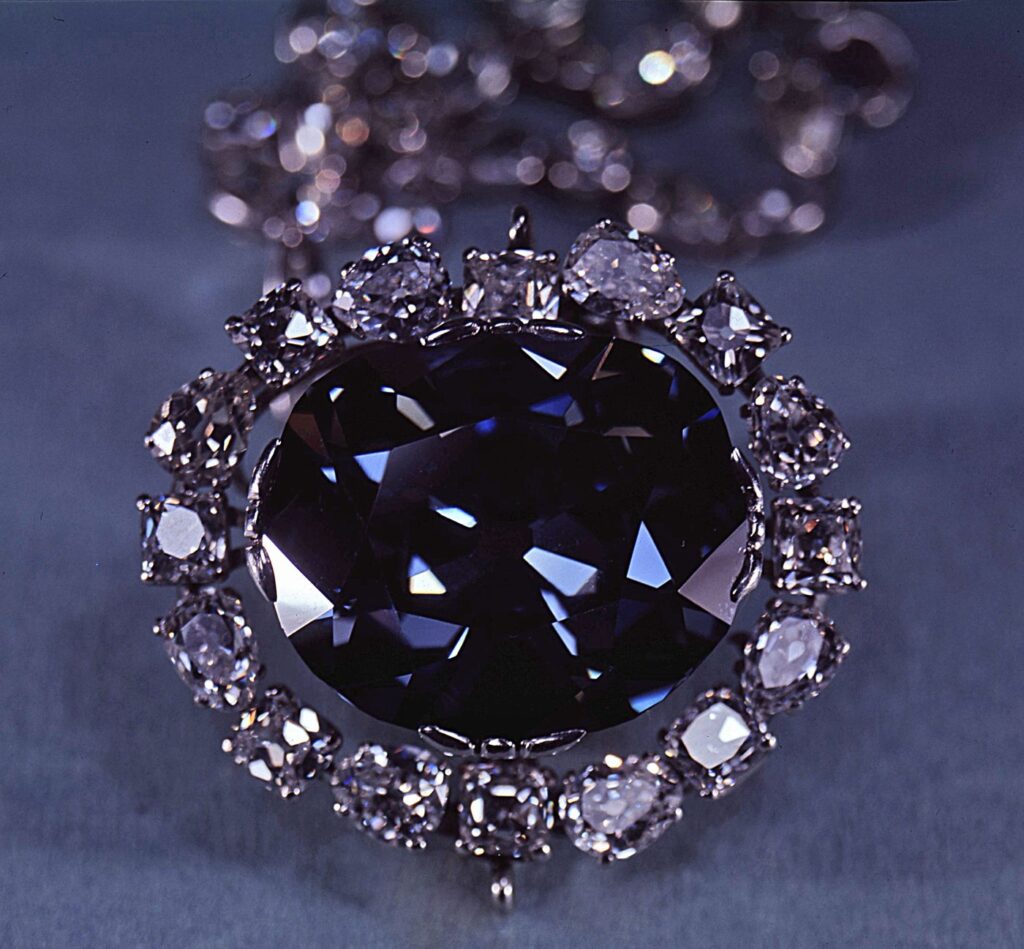 Public domain via Smithsonian Institution Archives (Wikimedia Commons)
Reader’s note: legends and folklore are presented as reported stories and beliefs, not established fact.
It sits behind bulletproof glass in Washington, D.C., and millions of people file past it every year to stare at a deep-blue stone the size of a walnut. The Hope Diamond is the most visited object in the Smithsonian’s National Museum of Natural History — and it is also, supposedly, the most cursed object in America.
The curse, as it is usually told, goes like this: the diamond was pried from the eye of a statue of the Hindu goddess Sita in India, and her wrath has followed it ever since. Every owner has paid. A French king and queen lost their heads. A banking family went broke. An American heiress lost her son, her marriage, and her daughter. Even the mailman who delivered it to the Smithsonian was struck by tragedy within a year.
It is a magnificent story. It is also, for the most part, a sales pitch.
Smithsonian anthropologist Richard Kurin spent more than a decade tracing the curse’s paper trail for his 2006 book, Hope Diamond: The Legendary History of a Cursed Gem. What he found was not an ancient curse but a modern one — assembled in Paris around 1910 by a jeweler who needed to sell a very expensive stone to a very rich woman, and polished by newspapers ever since. The debunk, in this case, is the story. And the stone’s real history, which runs from an Indian diamond mine to a brown paper parcel in the U.S. mail, is stranger than anything the curse invented.
The curse as told
In Cartier’s version — the version that hardened into legend — the Hope Diamond began as the eye of a statue of Sita, wife of the god Rama, in an Indian temple. A priest or thief stole it, and the goddess cursed it: misfortune and death would follow anyone who possessed it.
From there, the story attaches a disaster to nearly every hand the stone passed through. Jean-Baptiste Tavernier, the French gem merchant who brought it out of India, was supposedly torn apart by wild dogs in Russia. Louis XIV, who bought it, suffered misfortunes. Louis XVI and Marie Antoinette, who inherited it as part of the French Crown Jewels, were guillotined. The Hope banking family, who gave the stone its name, was ruined. Evalyn Walsh McLean, the Washington socialite who owned it for 36 years, watched her family unravel. The chain of victims is long, specific, and almost entirely wrong.
The real history
The stone itself is real, and its documented journey is remarkable enough without a curse. It was mined in the 17th century at Kollur, in India’s Golconda region, then the center of the world’s diamond trade. The French gem merchant Jean-Baptiste Tavernier acquired a rough blue diamond weighing over 112 carats there and sold it to King Louis XIV of France in 1668. The king’s court jeweler recut it to around 67 carats, and it became the French Blue — Le bleu de France — worn by the king on a ribbon and kept among the Crown Jewels.
In September 1792, during the chaos of the French Revolution, the French Blue was stolen from the royal treasury along with the rest of the Crown Jewels. It vanished for twenty years. It resurfaced in London in 1812, recut and reduced to 45.52 carats, its present size. It may have passed through the hands of King George IV; by 1830 it belonged to London banker and gem collector Henry Philip Hope, and it appears in an 1839 catalogue of his collection. That is where the name comes from — not from hope, but from Hope.
The Hope family kept it until 1901, when Lord Francis Hope sold it to pay off debts. It changed hands several times, and by 1910 it was in the possession of Paris jeweler Pierre Cartier. In January 1911, Cartier sold it to Evalyn Walsh McLean, daughter of a Colorado gold-mining millionaire and wife of Ned McLean, owner of the Washington Post. She owned it until her death in 1947. New York jeweler Harry Winston bought it from her estate in 1949, toured it for a decade in his “Court of Jewels” exhibition, and on November 10, 1958, donated it to the Smithsonian — sending it there by registered mail, in a box wrapped in brown paper, insured for $1 million, at a total shipping cost of $145.29. Just $2.44 of that was postage. The wrapper is now preserved at the National Postal Museum, and the diamond became Smithsonian specimen #217868.
How the curse was made
Here is where Kurin’s detective work dismantles the legend, owner by owner.
Tavernier was not torn apart by dogs in Russia. He died of natural causes in Moscow at the age of eighty-four. Louis XIV did not suffer for owning the stone; he died at seventy-seven of gangrene in his leg, after a sixty-year reign that was among the longest in European history. Marie Antoinette did wear the diamond — and she was guillotined — but she was guillotined because of the French Revolution, not because of a gemstone. The Hope family did lose its fortune, and Lord Francis did sell the stone to pay debts, but a banking family spending itself into ruin over two generations is not evidence of a curse; it is evidence of a banking family.
So where did the curse come from? Kurin traced it to Cartier’s sales campaign. Evalyn Walsh McLean collected objects for their stories as much as for their beauty, and Cartier understood his client. He assembled the chain of doomed owners — borrowing, Kurin found, from the plot of Wilkie Collins’s 1868 novel The Moonstone, about a cursed Indian diamond stolen from a Hindu idol — and aimed it at her. The pitch worked. She bought the stone, and she wore it everywhere, at parties and charity events, sometimes letting brides wear it on their wedding days.
One honest complication: Cartier did not invent the curse from nothing. A Washington Post feature in 1908 and a London Times piece in June 1909 had already catalogued supposed victims before Cartier owned the stone. The curse was existing tabloid folklore. What Cartier did was pick it up, polish it, aim it at exactly the right buyer, and give it the one thing folklore needs to survive: a famous owner whose real life would seem to confirm it.
Why the curse stuck
Evalyn Walsh McLean’s tragedies were real, and that is why the legend survived its own debunking. Her nine-year-old son Vinson was killed by a car in 1919. Her marriage to Ned McLean collapsed amid infidelity and divorce. Her daughter died young in 1946. Newspapers, which had been playing up the curse angle since her son’s death, treated each new tragedy as fresh proof. The pattern was read backwards into a life that, like any life stretched across wealth and decades, was always going to contain misfortune.
The legend kept growing even after the stone left private hands. When Winston mailed the diamond to the Smithsonian, letter carrier James G. Todd picked it up at Washington’s city post office and delivered it to Smithsonian Secretary Leonard Carmichael in a small ceremony. Lore soon claimed Todd suffered a run of misfortune in the following year — car accidents, his wife’s death, his dog’s death, a house fire. The public reaction was intense enough that some Americans wrote to President Eisenhower urging the Smithsonian to refuse the “cursed” gift. The museum accepted it anyway.
That is the mechanism of a modern curse: a story told well enough, attached to a famous enough object, with just enough real tragedy in the vicinity, becomes self-sustaining. Every misfortune near the stone is counted as evidence. Every long, happy life near it — and there have been many, including the Smithsonian curators who have handled the stone for nearly seventy years without incident — is quietly ignored.
The stone today
The Hope Diamond has now sat in the Smithsonian for nearly seventy years, longer than it spent with any private owner, and its “curse” has produced nothing but good fortune for the museum: it anchors the National Gem Collection and draws millions of visitors a year to the Janet Annenberg Hooker Hall of Geology, Gems, and Minerals. Harry Winston, for his part, never believed in the curse at all; he donated the stone in the hope that it would help the United States build a national gem collection, and by that measure it worked spectacularly.
The science is as strange as any legend. The stone’s blue comes from trace amounts of boron in its crystal structure, and under ultraviolet light it phosphoresces — glowing red after the light is switched off. It is 45.52 carats of fancy dark greyish-blue diamond, antique cushion cut, valued in the hundreds of millions of dollars, more than a billion years old. It formed deep in the Earth long before there were humans to curse it, and it will outlast every story told about it.
That is the real verdict on the Hope Diamond curse. It was not cast by a goddess in a temple. It was assembled by a jeweler in Paris, polished by newspapers, and confirmed by the genuine tragedies of a woman who loved the stone and wore it anyway. The curse is a story about how stories work — and the diamond, indifferent and blue, just keeps sitting behind its glass, outliving all of them.
Frequently Asked Questions
Is the Hope Diamond really cursed?
There is no evidence for a curse, and the documented history argues against one. Smithsonian anthropologist Richard Kurin traced the curse story to a sales pitch assembled by jeweler Pierre Cartier around 1910, drawing on existing tabloid folklore and on Wilkie Collins’s 1868 novel The Moonstone. The supposed victims’ real fates don’t match the legend: Tavernier died of natural causes at 84, Louis XIV died at 77 after a 60-year reign, and Marie Antoinette was executed because of the Revolution, not a gemstone. Smithsonian curators have handled the stone for nearly seventy years without incident.
Who invented the Hope Diamond curse?
No single person invented it from nothing — a Washington Post feature in 1908 and a London Times piece in June 1909 already listed supposed victims. But Pierre Cartier assembled the modern version into a sales pitch aimed at Evalyn Walsh McLean, who bought the diamond in January 1911. Kurin’s research shows Cartier borrowed beats from The Moonstone and polished the chain of doomed owners to make the stone more attractive to a buyer who collected stories as much as jewels.
Was the Hope Diamond stolen from a Hindu statue?
There is no evidence for that. The idol story — that the stone was pried from the eye of a statue of the goddess Sita — is part of Cartier’s sales tale, and it echoes the plot of The Moonstone. The documented record begins in the 17th century, when French merchant Jean-Baptiste Tavernier acquired a large rough blue diamond at India’s Kollur mine and sold it to Louis XIV in 1668.
What happened to Evalyn Walsh McLean?
Her tragedies were real, and they are the main reason the curse legend survived. Her nine-year-old son Vinson was killed by a car in 1919; her marriage to Ned McLean collapsed; her daughter died young in 1946; and Evalyn herself died in 1947. Newspapers treated each tragedy as proof of the curse. But a wealthy family experiencing misfortune across four decades is not evidence of a supernatural cause — it is, sadly, an ordinary pattern of human life.
Can you see the Hope Diamond today?
Yes. It is on permanent display in the Janet Annenberg Hooker Hall of Geology, Gems, and Minerals at the Smithsonian’s National Museum of Natural History in Washington, D.C., where it has sat since Harry Winston donated it on November 10, 1958. It is the museum’s most visited object, drawing millions of visitors a year.
Keep exploring
The Salem Witch Trials: Two Hundred Accused, Twenty Dead, and Not a Single Witch
Every October, more than a million people pour into Salem, Massachusetts — 1.1 million unique visitors in October 2025 alone, 96,600 of them on Halloween Day…
Read story →
Jack the Ripper: Five Women, One Autumn, and a Name Made of Ink
Jack the Ripper is the most famous name in true crime. It has filled libraries, launched a hundred suspects, and sold walking tours through Whitechapel every…
Read story →
The Lost Colony of Roanoke: One Word, 115 People, and 400 Years of Searching
On August 18, 1590, Governor John White waded ashore on Roanoke Island expecting to find his family. His daughter Eleanor was there. His son-in-law Ananias Dare…
Read story →